She’s not struggling to visualise your space. She’s refusing to guess.
A developer said something to me today and it’s a topic that’s so close to my heart, I had to blog about it!
He builds really large homes, around 300 square metres. Proper family-sized new builds with rooms that need serious filling. And over the years, he’s noticed a pattern on viewings: women seem to struggle more than men to picture how the space will actually work. Men, by comparison, don’t ask as many questions. They don’t seem to hit the same wall.
He wasn’t being funny about it (by ‘funny’ I mean sexist of course). He’d genuinely clocked it after several decades of building and of meeting prospective buyers.
It immediately took me back to a blog I wrote in April 2025, Why Women Drive Home Buying Decisions and How Property Staging Will Help You Sell Faster, on this very topic. I’d noticed the same pattern myself, over dozens of conversations across the years with friends, prospective buyers, sales directors and developers: women consistently seemed to need more explanation when it came to the spatial layout of a property.
So I dug into it and did some research.
I realised that the story lines up with a lazy old stereotype: women “can’t visualise”, men just “get it.”
I wasn’t having that!
Before you rush to defend the men on the viewing (or the women, for that matter), let’s be clear: this isn’t a “them and us” thing. It’s a science thing.
So what does the actual science say?
Do Women Really Struggle to Visualise Property?
Guess what? The research doesn’t back the stereotype.
Spatial ability isn’t one thing. Psychologists break it into several distinct skills. Mental rotation (spinning a 3D shape in your head) does show a real, consistently replicated gap favouring men.
But spatial visualisation, the specific skill of imagining how a room could be used, furnished and lived in, shows one of the smallest gender differences ever measured in cognitive psychology, in some meta-analyses close to zero (Purdue, Springer).
This isn’t made-up mumbo jumbo. It’s a documented fact, backed by decades of behavioural science.
So if it’s not ability, what is it?
To answer that, I want to go back to something I touched on in my original blog, because it turns out to be the whole explanation.
Why Women May Read a Home Differently
It goes back to the cave…
Strip it right back to hunter-gatherer roles. Men went out. They hunted, gathered, ranged across unfamiliar territory, took the risk on the unknown. Women held the base; managed it, protected it, made decisions about safety, warmth, food storage and how a finite space would support a family through every season and every crisis.
That division not only shaped who did what, it shaped who had to read an environment properly, because getting it wrong had real consequences for the people depending on you.
That inheritance didn’t disappear when we swapped caves for new builds. It’s why, as I wrote last year, women are more likely to process and respond to emotional and environmental cues in domestic spaces and why, neurologically, women tend to have a more active insula, the part of the brain that processes empathy, emotion and internal state.
It means they’re often picking up on subtle cues from lighting, layout and clutter that men may simply walk past. Not because men can’t see them. Because historically, it was never their job to check.
And to be clear, this isn’t a slight on the male buyer. Plenty of men are just as tuned into layout, light and flow as any woman on a viewing. But statistically, far more women than men lead the home buying decision, and that’s the pattern developers are actually seeing play out on site.
Why Women Ask More Questions on Property Viewings
Roll forward to a viewing in 2026, and the pattern hasn’t gone anywhere.
Women are still the primary or final decision-maker in somewhere between 78% and 91% of UK home purchases, depending on which study you look at (Wise, Bankrate/TSAHC), and it’s holding up.
That’s a huge percentage!
And the same instinct that once meant ‘read the cave properly or the family suffers’ now shows up as ‘ask enough questions to know this house will actually work.’
She’s arriving pre-briefed, too.
This isn’t only about what happens on the viewing itself. Research from Savills has found women increasingly dominating property purchasing decisions, and not just in residential, in buy to let and investment too, as dual income couples navigate big-ticket choices together.
Separate research from the HomeOwners Alliance found women are more likely to initiate a move in the first place, shortlist the properties worth seeing, and do the groundwork on everything from local schools to commute times before they ever set foot on site.
In other words, by the time she’s standing in your 300 sqm shell, she’s often already done more homework than her male partner.
She’s not walking in cold and “struggling.” She’s walking in with a checklist she built weeks ago, and she’s testing your house against it in real time.
That’s not confusion, it’s due diligence.
What She’s Actually Doing When She Asks ‘But Where Does This Go?’
Go back to the three things I said drive the female buyer: emotional connection, functionality, aesthetics. On a viewing, all three are running at once, mostly invisibly.
She’s mentally placing the sofa. Imagining Christmas dinner in that dining room. Picturing the kids doing homework at the kitchen table while she cooks.
That’s the emotional connection doing its work but it’s also cognitive load, because she’s simulating a whole life in a room that currently has none of it.
A well staged home short-circuits that work: it feels intentional rather than just styled, and it invites her to start emotionally unpacking before she’s even made an offer.
At the same time she’s running the functional check: is there anywhere to hide the toys, the laundry, the three different bins we all seem to need now? Can she cook, chat, and keep half an eye on the kids without fighting a bad layout? Is the light flattering, or does it turn the whole room grey and lifeless by 3pm in January?
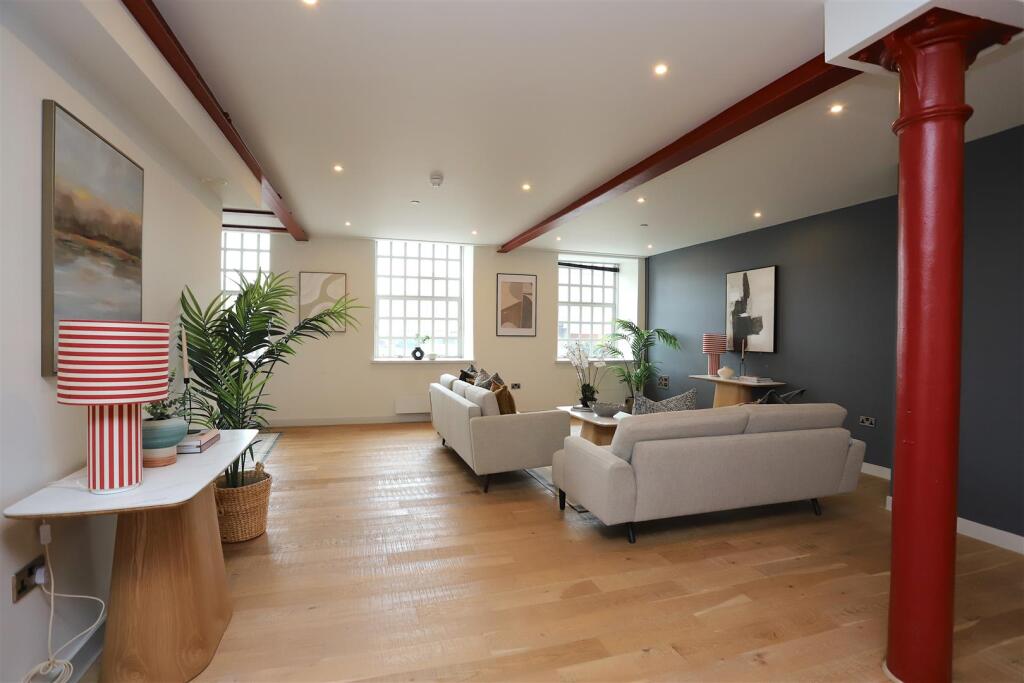
A kitchen island that doubles as a breakfast bar answers half these questions before she’s asked them. It tells her without using words that this home doesn’t just look good, it works for real life.
And underneath both, she’s reading the aesthetics; whether the palette feels calm or chaotic, whether the flow from room to room feels intentional or thrown together.
That’s not ‘just a vibe.’ It’s the same environmental literacy her ancestors needed to keep a home safe and functioning, now aimed at a five-bed new build instead of a cave.
That’s three simultaneous evaluations happening on a twenty-minute viewing.
Of course it produces more questions. It should.
Why Empty New Builds Are Harder for Buyers to Visualise
Every buyer struggles to visualise an empty property to some degree.
According to multiple sources, as few as 1 in 10 can accurately picture an unfurnished space unaided, and staging is proven to close that gap: 83% of buyers’ agents say it makes it easier for buyers to see a property as their future home (NAR).
Now scale that visualisation problem up to 300 square metres of open, undefined space.
You’re not asking someone to imagine one sofa in one room. You’re asking your most engaged, most scrutinising decision-maker to solve an entire household’s logistics (sofa, dinner table, homework spot, toy storage, bin cupboard, light at every time of day) in her head, unaided, in the time it takes to walk the plot.
No wonder she has more questions.
She’s doing more work.
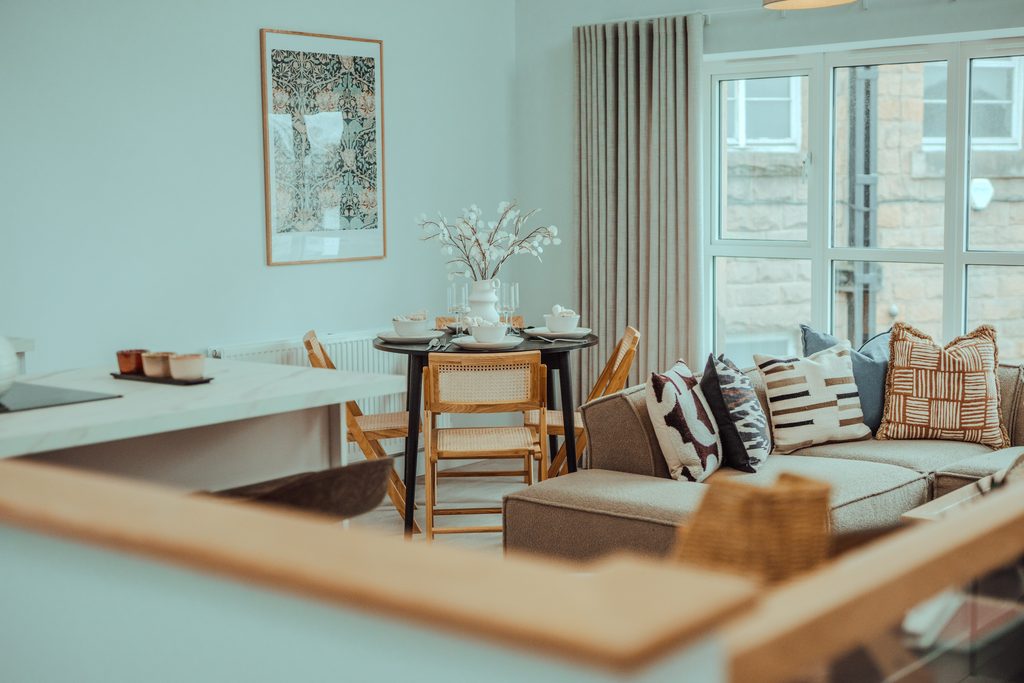
How Property Staging Helps Developers Sell New Builds
If your sales team is quietly reading a woman’s questions on a viewing as hesitation, or a stall, they’re misreading the room.
Research-backed diligence is a buying signal, not a red flag. She’s doing more work to say yes, not less work to say no.
And by showcasing a property’s true potential rather than leaving it to her imagination, you speed up that decision, get her more excited, and set yourself up for stronger offers, not weaker ones.
The fix isn’t complicated, and it’s the same one I’ve always pushed.
Neutral, warm palettes
Pale to mid-strength tones that let the widest range of buyers project their own life onto the space, rather than a bold designer statement that only speaks to one type of buyer.
(Please, also, no navy blue feature walls. Why is everyone still doing that?)
Functional, zoned layouts
Especially in open-plan living/kitchen/dining and the “awkward” rooms every big new build has one of.
Show what the space is for, don’t leave it to her to work out.
Sensory details
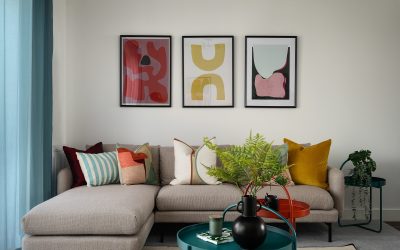
Greenery, layered textiles, warmth. The things that answer the aesthetic and emotional check before she’s had to ask a single question about it.
Do that, and you’re not decorating.
You’re pre-answering every question she’d otherwise have to raise herself, which is exactly where speed of sales and GDV get protected.
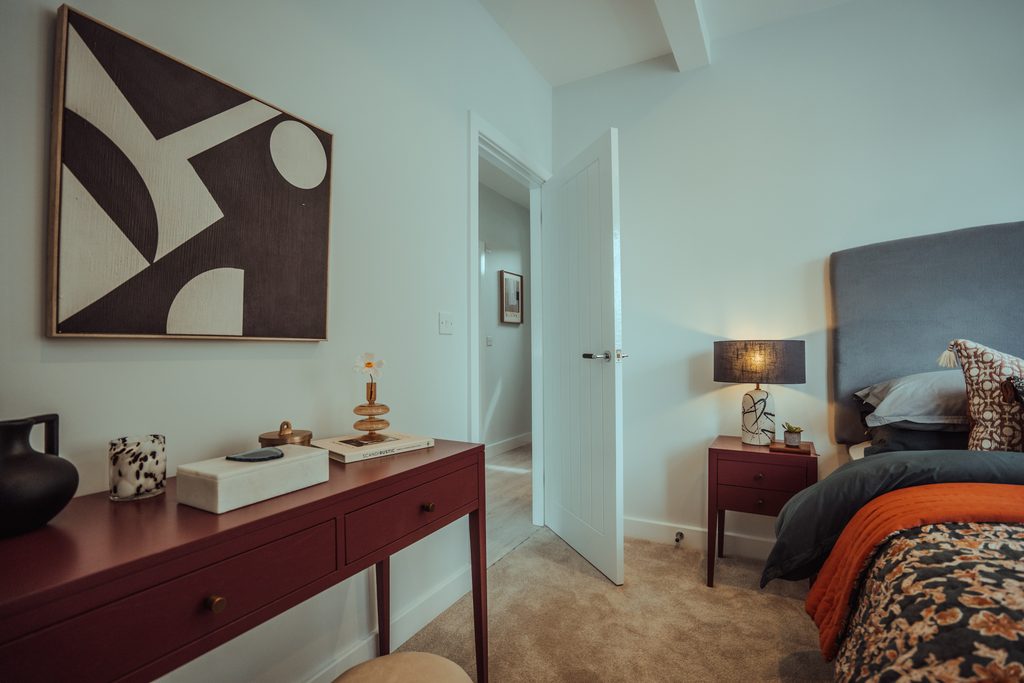
Why Show Home Design Is a Commercial Decision
We’re in an era of rising loneliness, and connection is what people crave more than almost anything else.
A home that answers her questions before she asks them doesn’t just sell faster, it feels like somewhere she already belongs.
That’s the difference between ‘this could work’ and ‘this is the one.’
She was never the one struggling, she was asking the right questions.
The opportunity is building homes, and show homes, that answer them before she has to.
Are you leaving too much to your buyers’ imagination?
If you’re developing homes to sell, good design isn’t just about making them look good. It’s about helping buyers understand the space, connect with it and see exactly how it could work for them.
If you want to make commercially smart design decisions that help protect your GDV and get homes sold, let’s talk.